Hit enter to search or ESC to close
Integrating natural light into expansive industrial envelopes often presents a conflict between energy efficiency and structural security. While traditional glass is fragile and solid metal is opaque, the adoption of specialized polycarbonate solutions has shifted how architects approach daylighting in large-scale facilities.
The shift toward sustainable building standards requires materials that reduce reliance on artificial lighting without compromising thermal insulation. This is where the technical properties of multi-wall polymers become critical, offering a lightweight yet resilient alternative to traditional roofing materials.
Understanding the operational advantages of a China Hollow PC Lighting Tile is essential for project managers seeking to optimize the balance between luminosity, durability, and installation speed in modern steel structure projects.


Historically, industrial roofing relied on heavy glass panels or simple translucent plastics that suffered from rapid yellowing and fragility. The development of the hollow-core polycarbonate structure addressed these failures by introducing a multi-layered geometry that traps air, significantly enhancing impact resistance while reducing the overall weight of the roof.
Today, these tiles are no longer just "skylights" but integrated components of the building envelope. By utilizing advanced UV-stabilization, the China Hollow PC Lighting Tile maintains clarity over decades, preventing the brittle failure common in first-generation polymer sheets.
The core strength of hollow PC tiles lies in their "honeycomb" or multi-wall architecture. This design creates a high moment of inertia, allowing the panels to withstand significant snow loads and wind pressure without the need for excessive secondary framing. This structural efficiency directly reduces the cost of the supporting steel structure.
Unlike solid sheets, the air gaps within the hollow tiles act as a buffer. When an external impact occurs—such as hail or falling debris—the energy is distributed across the cell walls rather than concentrating at a single point of failure. This makes them nearly unbreakable compared to tempered glass.
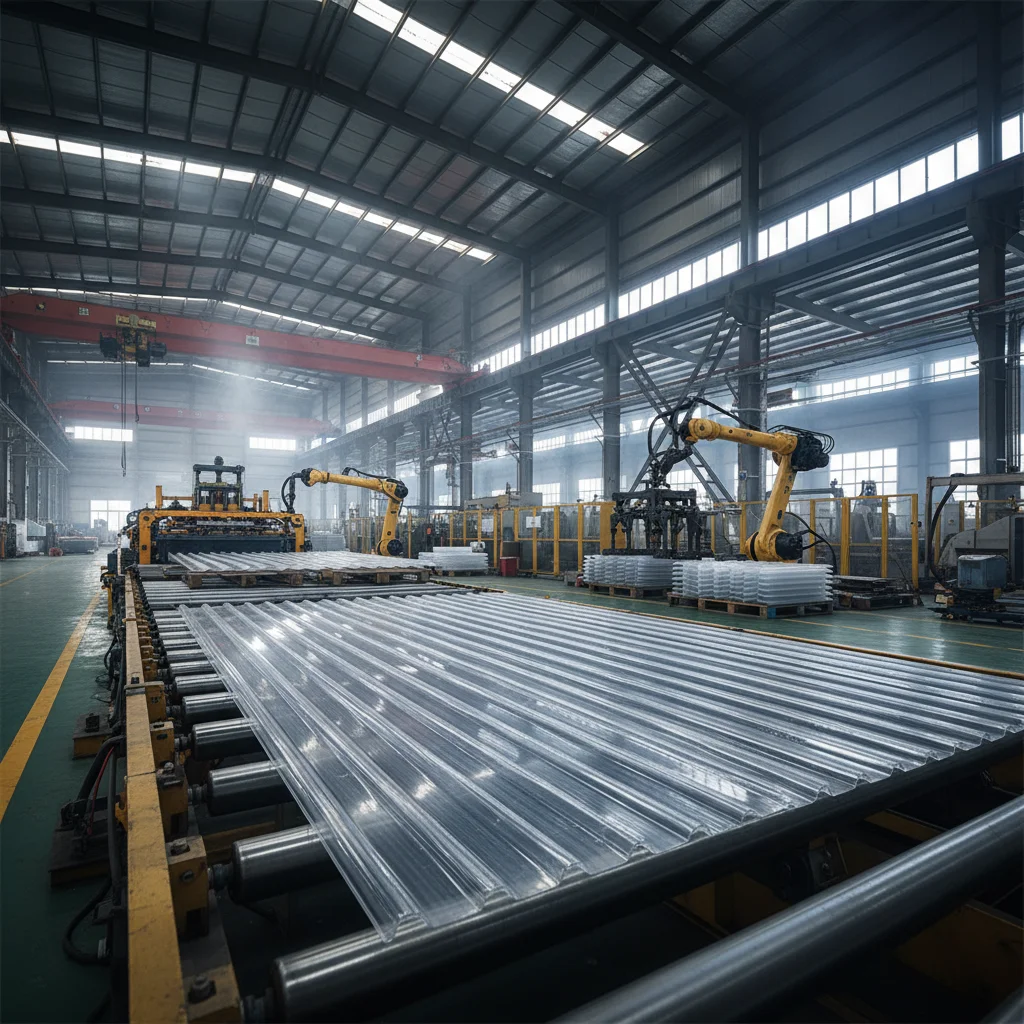
From a manufacturing perspective, the precision of the extrusion process ensures that the tiles fit seamlessly with corrugated metal sheets. This compatibility allows for a rapid-fix assembly, minimizing leakage risks at the joints and reducing the labor hours required for installation.
Thermal bridging is a primary concern in metal-clad buildings. The integration of hollow PC lighting tiles helps mitigate this by providing a break in the conductive metal surface. The stagnant air trapped within the cells provides an inherent R-value that exceeds that of single-skin glazing.
The strategic deployment of hollow polycarbonate tiles transforms the roof from a passive cover into an active energy-saving tool, reducing internal HVAC loads by optimizing passive solar gain during winter and diffusing harsh glare during summer.
By diffusing direct sunlight, these tiles eliminate "hot spots" on the factory floor, creating a more uniform lighting environment. This not only improves worker safety and comfort but also reduces the kilowatt-hour consumption of industrial LED arrays during daylight hours.
When evaluating the efficacy of lighting solutions, engineers focus on the trade-off between light transmission and thermal insulation. A high-quality hollow PC tile must maintain a transmission rate that allows sufficient lux levels on the work surface while keeping the U-value low enough to prevent excessive heat loss.
The following index represents a qualitative assessment of hollow PC tiles compared to traditional industrial roofing materials across five critical performance vectors.
In large-scale logistics centers, where ceiling heights often exceed 12 meters, the use of hollow PC tiles is strategic. By placing these tiles in longitudinal strips, operators can illuminate the central aisles of a warehouse without installing thousands of additional light fixtures, drastically lowering operational overhead.
Beyond warehousing, these materials are increasingly used in prefabricated housing and temporary industrial shelters. Because they are lightweight and easy to transport, they support the rapid deployment of site offices and assembly workshops, aligning perfectly with the modular construction trends seen in Shanghai's industrial hubs.
The next generation of polycarbonate lighting is moving toward "smart" transmission. Research is focusing on photochromic layers that can automatically adjust the level of transparency based on the intensity of the sun, preventing overheating in tropical climates while maximizing light in overcast conditions.
Sustainability is also driving the shift toward recyclable polymers. As global building certifications like LEED become standard, the demand for materials that can be fully reclaimed at the end of the building's life cycle is increasing. This ensures that industrial expansion does not come at an unacceptable environmental cost.
Furthermore, we are seeing a convergence between lighting tiles and integrated PV (photovoltaic) cells. The goal is to create transparent roofing that not only lets light in but also captures solar energy, turning the entire roof of a factory into a power plant.
Choosing the right translucent material requires a rigorous assessment of the environment. While a hollow PC tile is ideal for high-impact and high-insulation needs, other materials like FRP (Fiber Reinforced Plastic) or solid acrylic may be preferred for specific chemical resistance or aesthetic transparency requirements.
For projects involving complex steel structure enclosures, it is vital to ensure that the thermal expansion coefficient of the lighting tile matches the expansion joints of the metal roofing. Failure to do so can lead to stress fractures and leaks during extreme temperature swings.
The following framework provides a relative suitability guide for different industrial roofing options based on common project constraints.
| Material Type | Impact Resistance | Thermal Insulation | Installation Speed | Life-cycle Cost |
|---|---|---|---|---|
| Hollow PC Tile | Very High | High | Rapid | Low |
| Solid Polycarbonate | High | Moderate | Moderate | Moderate |
| Fiberglass (FRP) | Moderate | Low | Moderate | Moderate |
| Tempered Glass | Low | Low | Slow | High |
| Acrylic Sheets | Moderate | Moderate | Rapid | Moderate |
| Multi-wall PVC | Low | Moderate | Rapid | Low |
The primary difference is the internal structure. Hollow PC tiles feature multiple air chambers (cells) that provide significantly better thermal insulation and higher structural rigidity relative to their weight. Solid sheets offer superior optical clarity (similar to glass) but lack the insulation properties and are generally heavier and more expensive for large-scale industrial applications.
Premium China Hollow PC Lighting Tiles are treated with a co-extruded UV-resistant layer on the exterior surface. This specialized coating blocks harmful ultraviolet radiation from penetrating the polymer chain, which prevents the chemical breakdown that causes yellowing and brittleness, ensuring the tiles remain clear and strong for many years.
Yes, they are specifically engineered for this purpose. Most hollow PC lighting tiles are produced with corrugated profiles that exactly match standard steel sheet specifications. They can be installed as replacement panels or integrated during the initial construction of the steel structure, using standard fastening systems to ensure a watertight seal.
Thickness selection is primarily driven by the required load-bearing capacity (such as snow or wind loads) and the desired thermal insulation value. Thicker tiles generally offer higher structural strength and better R-values but may slightly reduce the total light transmission. Engineers must calculate the span between supports to determine the minimum necessary thickness.
They are highly cost-effective for temporary structures due to their lightweight nature and ease of installation. Since they reduce the need for heavy lifting equipment and artificial lighting, the total project cost is lowered. Additionally, their durability ensures they can be dismantled and potentially reused in subsequent projects.
Maintenance is minimal. Periodic cleaning with mild detergents and water is usually sufficient to remove dust and debris that could block light. It is important to avoid abrasive cleaners or harsh solvents that could scratch the UV-protective layer, as this would expose the polymer to premature degradation.
The integration of high-performance lighting solutions is no longer a luxury but a technical necessity for energy-efficient industrial design. By balancing structural integrity with light transmission, the hollow polycarbonate tile offers a pragmatic answer to the challenges of modern steel structure manufacturing.
As the industry moves toward smarter, more sustainable materials, focusing on the synergy between the building envelope and natural resource utilization will define the next era of industrial architecture.